Manifesto
New Science Manifesto
From Paper Publishing to Scholarly Curation
Public Abstract
Short Manifesto
The modern scholarly paper is not the natural form of knowledge. It is a historical media form shaped by print, postal circulation, learned societies, libraries, journal subscriptions, and academic evaluation. It was efficient and rigorous, and it deserves to survive.
But digital networks and AI have changed how research is produced, discovered, reviewed, reproduced, summarized, and reused. In 2026 even mathematics, the oldest discipline built on proof and authorship, is arguing about what AI should do: more than four thousand mathematicians signed the Leiden Declaration, twenty-five Fields medallists warned that solving is not understanding, and a 23-year-old with no advanced training used an AI model to settle a sixty-year-old Erdős problem. The question is no longer whether papers should exist, but whether they should remain the only finished form of scholarship; and no longer whether AI can do research, but what people do inside research, and whether ordinary people can join.
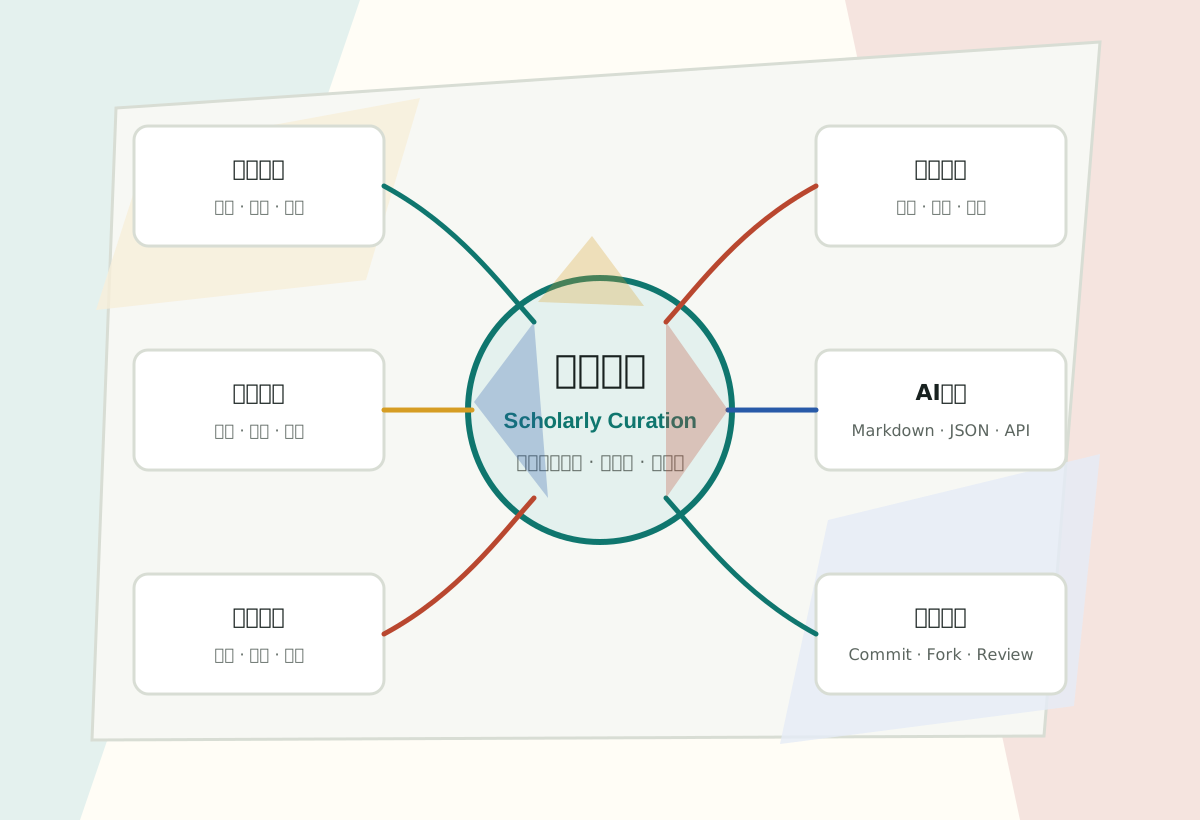
RenaSci argues for scholarly curation beyond the paper: a scholarly work that contains a paper view, public explanations, learning paths, open data, failed attempts, ethical and funding records, machine-readable formats, version histories, and open review. We call such a work a knowledge object. We also argue that the AI era, far from pushing people out of research, lowers the threshold for playing it: research can be started like a game, advanced in turns, read as turn reports, and rewound to an earlier save; some people play, and everyone can watch. For this we are building three things: a curation platform, a new kind of journal, and a research game engine called Wendao.